

The campaign brief was strong. The creators were a genuine fit. The content looked great. Six weeks later, the brand manager sat across from her CMO with a deck full of screenshots and a Google Sheet she’d been updating by hand. No consolidated view of what the campaign had actually done. Sound familiar?
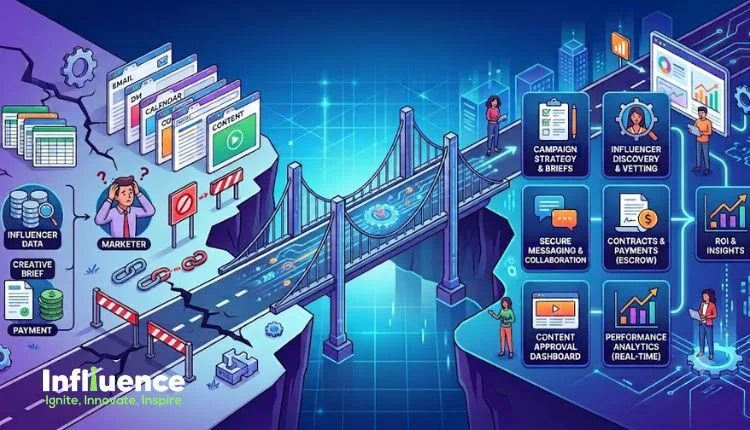
This is the most common failure mode in influencer marketing, and it almost never gets talked about honestly. Brands obsess over creator selection and content quality. Then execution gets handed off to a tangle of disconnected tools: a discovery platform here, a contract template in Dropbox, payments tracked in Excel, performance pulled manually from each creator’s account. The workflow kills the campaign — not the creators.
The Fragmentation Tax Nobody Budgets For
Consider what a mid-size e-commerce brand running 15 creators across a product launch actually juggles. Outreach logged in one CRM. Deliverable deadlines in another spreadsheet. Finance requesting invoices by email. A social analyst trying to reconcile reach numbers from five different platforms. Each handoff is a point of failure. Deadlines slip. Content goes live without proper disclosure language. A creator posts to the wrong handle and nobody catches it in time.
The operational overhead compounds fast. It’s not a small-brand problem either. As our research on agency campaign management put it bluntly: “We stayed late to cobble three reports into one ‘source of truth’ for Monday. That was the third Monday this month.” That’s an account manager’s quote, not a hypothetical. When each team exports a different CSV, decisions degrade into gut-feel bets — and wins can’t be proven or repeated.
This is precisely why Infliuence was built the way it was. The platform — trusted by 500+ brands across India — puts creator discovery, campaign execution, and performance tracking in one dashboard. The handoff problem disappears by design, not by discipline.
Why the Market Is Moving Toward Unified Infrastructure
The scale of this industry makes operational chaos harder to ignore. The influencer marketing industry has already grown 12% to $22 billion in 2025. That growth is not happening because brands are running more spreadsheets.
It’s happening because influencer marketing software that merges analytics, creator management, and campaign automation into a single ecosystem is finally making large-scale influencer programs operationally tractable. The brands scaling fastest have stopped treating influencer marketing as a series of one-off deals managed through email threads.
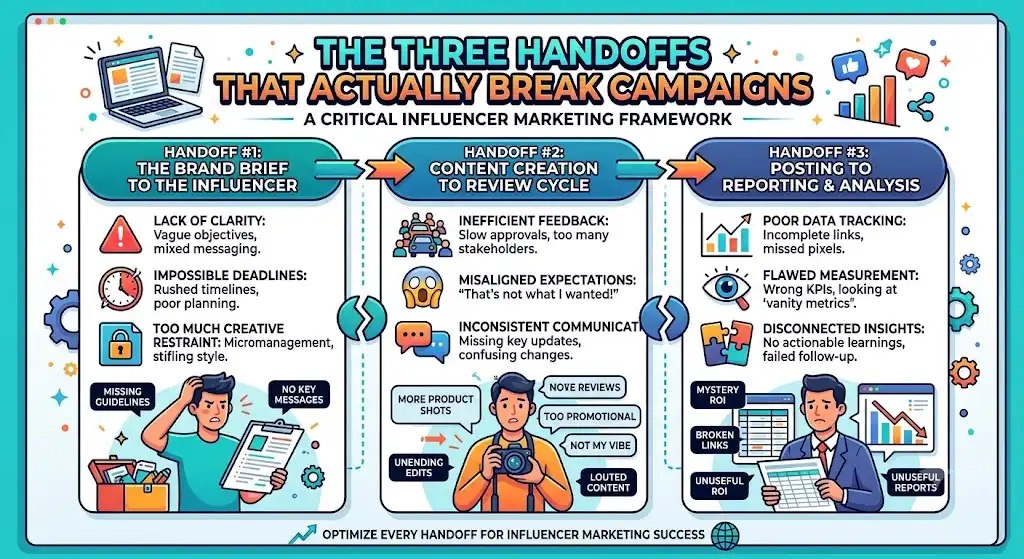
The Three Handoffs That Actually Break Campaigns
1. Discovery to Outreach
Most discovery tools export a CSV. You shortlist 30 creators, export them, paste them into an outreach tracker, then someone manually sends 30 cold DMs or emails. By the time half respond, your original data is stale and you’ve lost context on why you shortlisted creator #17 in the first place. Manual creator discovery via hashtag search and cold DMs burns weeks while still missing hidden-fit creators in micro and mid tiers. A platform that keeps discovery and outreach in the same workflow — with notes, status flags, and contact history attached to each creator profile — eliminates this cold-start problem on every campaign.
2. Contracting to Content Approval
This is where FTC and ASA compliance risk actually lives. A creator who never received a clear brief with disclosure requirements baked in is a creator who might post without #ad or #sponsored — and enforcement is landing on brands, not just creators. When the contract and the content approval checklist live in separate systems, things fall through gaps. Without clear usage rights and allowlisting permissions secured up front, brands can’t amplify winning content through paid social, leaving incremental sales on the table. When contracting and approval are unified, the content approval step can literally gate the payment step — which focuses everyone’s attention immediately.
3. Content Live to Reporting
This is the graveyard of campaigns. Content goes live. Someone spends two days manually pulling reach, engagement, story views, and link clicks from fifteen creator accounts. By the time the report is assembled, it’s been three weeks since the campaign ended and nobody remembers what decisions the report was supposed to inform.
Worse: ROI attribution breaks across screenshots, UTM links, codes, and platform exports that don’t align, producing reports no one fully trusts — and budgets get cut or pushed to paid search as a result. Real-time reporting turns the report from a post-mortem into a live performance tool. You can pause underperforming content mid-flight, not just eulogize it in a deck afterward.
What Good Infrastructure Actually Looks Like
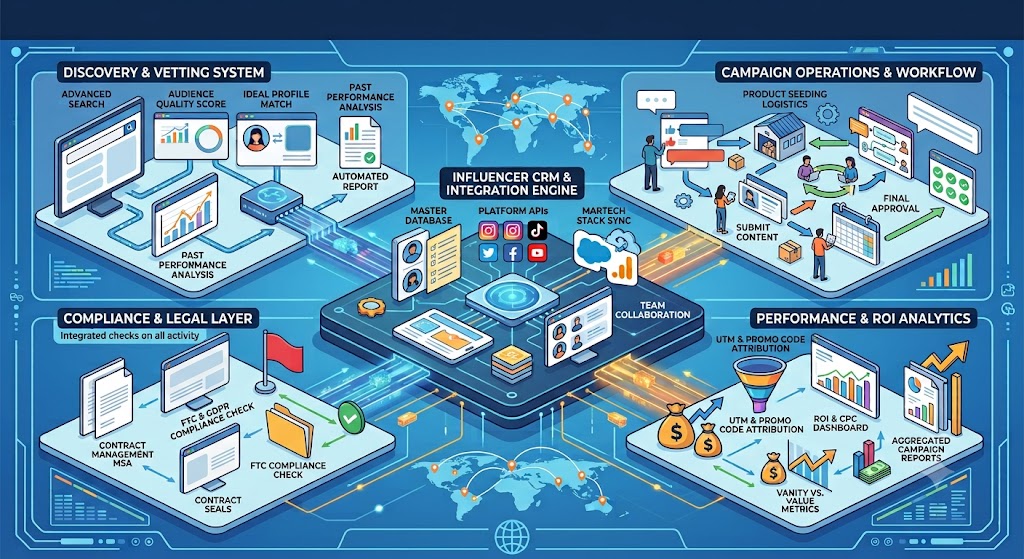
The brands getting the most out of influencer programs right now share a few operational traits that have nothing to do with budget size.
- One system of record for every creator relationship. Notes from past campaigns, deliverable history, content performance benchmarks — all attached to the creator profile, not locked in someone’s email thread.
- Templated workflows that enforce compliance. Brief approval, contract sign-off, content submission, disclosure verification, and payment — each step gated on the prior one being completed.
- Live dashboards, not end-of-campaign reports. If you can’t see your campaign’s aggregate reach while it’s still running, you’ve given up the ability to optimize it.
- Consolidated cross-platform metrics. A campaign running across Instagram, TikTok, and YouTube should produce one view, not three separate exports you stitch together in a pivot table.
The Platform Gap Nobody Warns You About
Linqia’s 2025 review of the top influencer marketing platforms flags a recurring gap across tools in this space. Discovery data doesn’t feed workflow execution. API connections to social platforms drop at inconvenient moments — and anyone who’s had TikTok API access go dark mid-campaign knows reliability matters as much as feature parity.
The depth of integration between the creator database and the execution layer is the variable that matters most. It’s also the hardest to evaluate from a demo — and it’s exactly what separates platforms that transform programs from ones that just add another login.
What unified infrastructure produces at scale is concrete. Burger King ran a campaign across 60 influencers on Infliuence and achieved 7.4M views, 1.2M engagements, and a 3.8x ROI. Separately, Olay Skincare’s summer influencer push hit 1.02M views with an 84% approval rate. Neither result comes from better creators alone. It comes from a workflow where the brief, the creator shortlist, the live metrics, and the reporting all lived in one place — and the team could optimize in real time rather than assemble a post-mortem. Tracking campaign ROI with that kind of granularity is only possible when every data point flows into a single dashboard rather than scattered exports.
Ready to run campaigns like this end to end? See how Infliuence handles discovery, execution, and reporting in one place — book a demo.
The One Internal Fix Most Brands Skip
A brand buys a sophisticated influencer marketing platform, then assigns it to one person — usually a social media coordinator — who lacks the authority to enforce the workflow with creators, finance, or legal. The platform becomes glorified creator-database software. Approvals still happen over Slack. Invoices still go to a separate accounts-payable inbox.
Platform adoption only works when every team that touches the campaign — finance, legal, marketing leadership — is bought in from day one. The VP of Marketing needs to pull reporting from the platform directly, not ask the coordinator to email a PDF. This is a change management problem as much as a software problem, and it’s worth solving explicitly before you onboard your first creator in the new system. Most users who set up the workflow before outreach begins go live within 24 hours — the platform isn’t the bottleneck. Internal alignment is.
If you’re evaluating platforms right now, the right question isn’t just “does this tool have the features we need.” It’s “can we actually run our whole campaign process here, end to end, without people defaulting to email and spreadsheets when the workflow gets complicated.” That’s the question that separates a platform that transforms your program from one that just adds another login to your day.
The influencer marketing industry is growing too fast for disorganized execution to be viable. The brands still running successful programs in three years are building real operational infrastructure now — not managing their hundredth creator relationship in a spreadsheet.
If your campaigns are falling apart in the handoffs, the fix isn’t a better brief template. It’s a better