


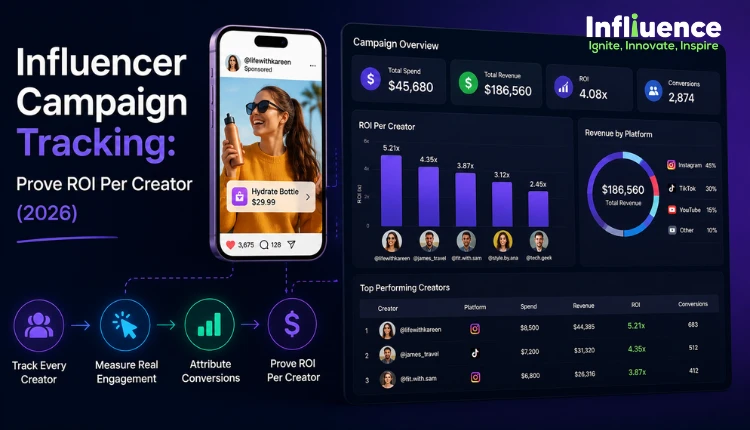
Sixty influencers. 7.4 million views. 3.8x ROI. Those numbers from a Burger King campaign run on Influence campaign tracking documented on the platform’s campaign results page exist because every creator had isolated, measurable attribution from day one: 1.2M engagements tracked back to individual posts, not blended into a campaign average. Most brands never produce numbers like that because the tracking setup can’t produce them.
This is the setup that changes that. Not a survey of options an opinionated workflow for brands who want to know exactly which creator drove revenue while the campaign is still live, enough to act on it.
Why most influencer tracking falls apart
The failure mode is almost always the same. A brand runs fifteen creators, screenshots a few Instagram Stories, exports likes into a spreadsheet, and calls it a report. Three problems surface immediately.
- Vanity metrics dominate. Likes and views feel good but don’t map to revenue. A reel with 400K views and zero attributed sales is a loss dressed as a win.
- Attribution collapses. Without unique links or codes per creator, you can’t separate the one who drove 60% of sales from the four who drove nothing. The budget re-books on follower count instead of evidence.
- Data goes stale. Manual spreadsheets are updated once, then abandoned mid-flight so you can’t reallocate budget while the campaign is still live. Real-time performance tracking is what separates brands that optimise mid-campaign from those who only learn what went wrong in the post-mortem.
Good tracking solves all three by giving each creator a measurable, isolated slice of the funnel from the first day of the campaign.
The 6 metrics worth tracking
Not every number deserves a column. These six give you a complete picture from awareness to revenue. The most critical influencer marketing KPIs consistently point to the same ladder: reach is a denominator, engagement confirms resonance, and CPA and ROAS decide who gets re-booked.
- Reach and impressions top-of-funnel size. Useful as a denominator, not a KPI on its own.
- Engagement rate (likes + comments + saves + shares) ÷ reach. A micro-creator at 6% often out-converts a macro at 1.2%.
- Clicks / link taps the first real signal of intent. Track per creator, never as a campaign lump sum.
- Conversions sign-ups, purchases, or whatever action you’re paying for.
- Cost per acquisition (CPA) total creator spend ÷ conversions. This is the number that decides re-bookings.
- Return on ad spend (ROAS) revenue ÷ spend. Brands earn an average of $5.78 for every $1 spent on influencer marketing, with top campaigns hitting $18–$20 per dollar use that range as your calibration point before you set a floor.
Why per-creator isolation changes every decision
Run two creators on the same brief with no separate attribution. At campaign end, your analytics show 120 purchases — but zero indication of how they split. You re-book by follower count because that’s all you have. This is the exact blind spot that proper Influencer Campaign Tracking is built to eliminate.
Per-creator tracking changes the decision entirely. You see that one creator’s promo code drove the vast majority of those purchases, at a fraction of the CPA of the other. That creator gets re-booked, the underperformer doesn’t, and the next campaign starts with a proven acquisition engine instead of a blank roster. Without isolated attribution, that decision stays invisible no matter how many impressions you report — which is why Influencer Campaign Tracking matters more than raw reach or follower count.
The mechanism that makes it visible is straightforward: every creator gets their own tracked link and their own discount code. Those two data streams together cover both the click-through buyer and the screenshot-and-buy-later buyer, who never touches the link at all. That’s Influencer Campaign Tracking working as it should — turning a single lump-sum result into a clear, creator-by-creator performance breakdown.
How to set up tracking that actually attributes
1. Build a consistent UTM structure
Give every creator a link with parameters you’ll never have to guess about later. Use a four-field convention:
- utm_source = platform (Instagram, TikTok, YouTube)
- utm_medium = influencer
- utm_campaign = the campaign name (spring_launch_2026)
- utm_content = the creator handle (jane_doe)
The non-negotiable rule: one unique link per creator, not one shared link for the whole campaign. Shared links collapse your attribution into a single meaningless row. Past five or six creators, the convention also needs documentation what you name each parameter becomes a shared language across your team and your analytics tool.
2. Assign a unique discount code per creator
Codes like JANE15 do double duty. They incentivise the purchase and attribute the sale even when the buyer never touched the link which covers most of Instagram Stories and in-feed TikTok traffic. Match the code to the same creator handle you used in utm_content. That alignment means the two data streams reconcile automatically in your reporting, with no manual lookup step.
3. Set your conversion window before launch
Decide upfront whether you’re counting conversions within 7, 14, or 30 days of the post. Influencer purchases skew later than paid search a 7-day window can meaningfully undercount considered purchases on higher-ticket products. Pick the window, document it, and apply it to every creator equally so your CPA comparisons are apples-to-apples.
Turn tracked data into decisions
Tracking is only worth the effort if it changes what you do next. Once data is flowing, run this loop weekly while the campaign is still live.
- Rank creators by CPA and ROAS, not reach. Your top three by revenue are your re-book list. The bottom quartile deserves a conversation or a cut.
- Kill or renegotiate underperformers early. A creator below your ROAS floor after two weeks rarely recovers. The budget freed up is better moved to the proven performers still running.
- Double down on the format that’s winning. If TikTok demos out-convert static Instagram posts, shift the next brief accordingly. Platform and format interaction matters as much as creator size the data on this is consistent across categories.
- Save winners to a roster. Your next campaign starts with proven performers, not a blank search. This is the difference between running a campaign and building a program each cycle starts warmer and cheaper than the last.
Manual vs. platform tracking
You can do all of the above in spreadsheets. Whether you should depends on scale. For a two-creator test, a manual UTM sheet is fine. Past roughly five creators, the reconciliation work — matching codes to links to platform exports to your store’s revenue data — eats more time than most teams budget for, and errors compound fast across a roster. This is usually the point where teams start looking for dedicated Influencer Campaign Tracking instead of patching together sheets.
A purpose-built platform removes the reconciliation entirely. In Infliuence, the workflow runs in one place: filter and shortlist creators by niche, region, and engagement level, then launch the collaboration. From there, Live Campaign Dashboards stream reach, engagement, and ROI per creator in real time — no separate export step, no copy-paste between tools. This is Influencer Campaign Tracking built directly into the platform rather than bolted on after the fact. Brands on Infliuence’s Verified Influencer network are typically live within 24 hours when the workflow is set before outreach begins.
For D2C startups, e-commerce labels running product seeding at volume, or enterprise teams replacing agency middlemen, that shift from manual reconciliation to live per-creator data is where the compounding starts. The influencer marketing platform market sits at $34.2B in 2025 and is projected to reach $116.2B by 2033 — brands are moving budget here precisely because platform-level Influencer Campaign Tracking makes the ROI case that spreadsheets can’t.
If you’re building out your reporting approach, the Infliuence guide to campaign analytics and ROI tracking covers how to structure your reporting cadence once the data is flowing. And if you’re still selecting which creators to track in the first place, the guide to choosing an influencer CRM and creator database walks through what to look for before you build your roster.
The one thing that ends most tracking programs
It isn’t the wrong tool or the wrong metrics. It’s setting up attribution per creator for the first campaign, getting clean data, and then launching the next campaign with a shared link because it was faster. The compounding only happens if the discipline holds. Every shortcut back to blended attribution resets the clock.
Track every creator in one place
Most teams waste the first week of a campaign wiring up spreadsheets that break by week three. Infliuence handles creator discovery, collaboration launch, and live performance monitoring from a single dashboard from ₹299/month for creators, trusted by 500+ brands across India. Your links are attributed before the first post goes live, and you’ll see which creators are actually driving revenue before the budget runs out.
Start your free Infliuence trial your first campaign dashboard is live in under 24 hours.